
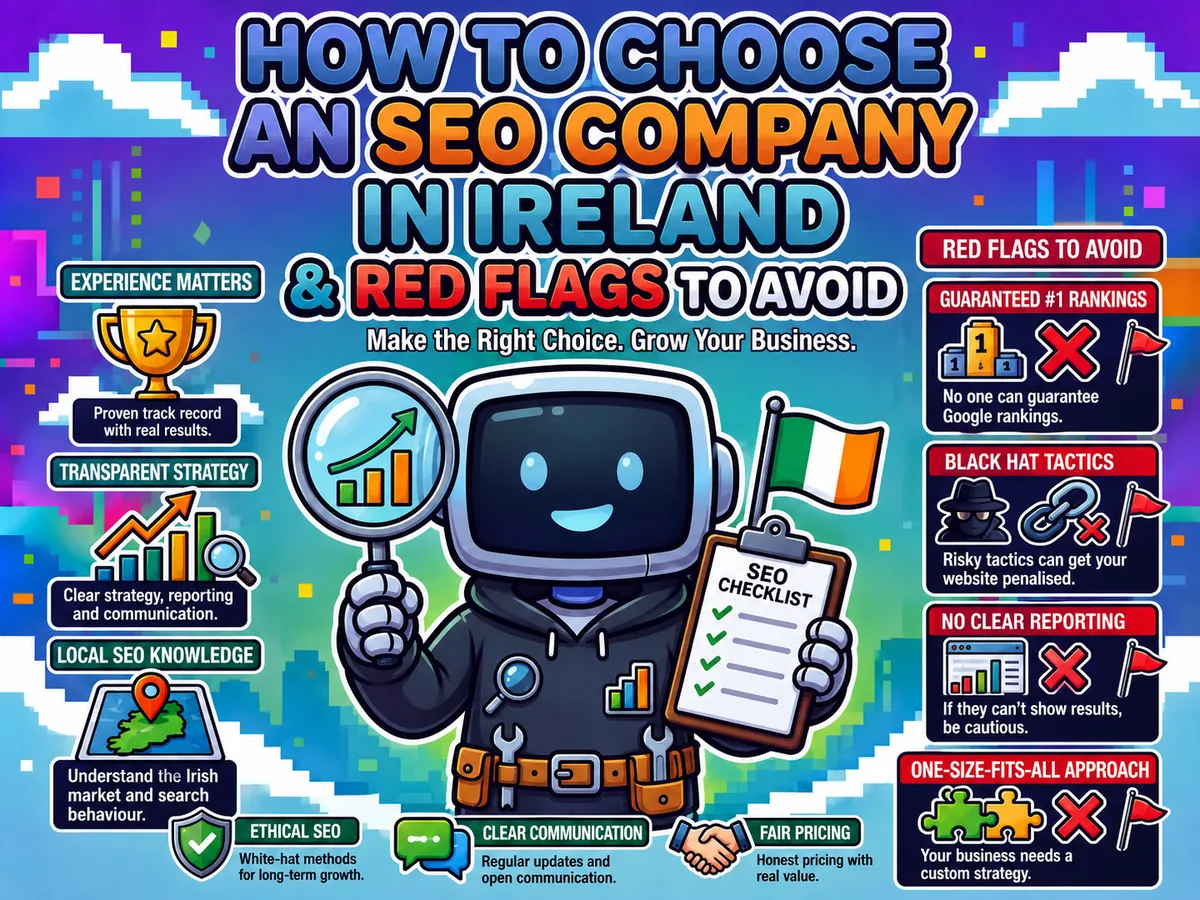
Every Irish small business owner I talk to has the same worry when it comes to hiring an SEO company: how do you tell a genuinely good one from someone who'll take your money and deliver nothing? Unlike a website, where you can see the finished product immediately, SEO results take three to six months to show up — which means by the time you realise you've hired the wrong company, you've already lost half a year and a few thousand euro, and possibly picked up a Google penalty that takes even longer to clean up.
This isn't a small decision. A bad SEO company doesn't just waste your budget — it can actively damage your website's ability to rank for years afterward if they've used manipulative tactics. Here's how to actually vet one properly before you sign anything.
Why Hiring for SEO Is Different From Any Other Marketing Hire
When you hire a graphic designer or a social media manager, you can judge the work almost immediately — you either like the design or you don't. SEO doesn't work that way. Google takes time to recrawl, reindex, and re-evaluate your site, and even good SEO work can look like it's doing nothing for the first two or three months. That delay is exactly what bad operators exploit — by the time you realise nothing is improving, you're often locked into a 12-month contract with penalty clauses for leaving early.
This is also why so many Irish businesses get burned: it's genuinely hard to tell a skilled SEO practitioner from someone reading a checklist off a template, at least until you know what to look for.
The Different Types of SEO Services (and What You're Actually Paying For)
"SEO" isn't one single service — it's a bundle of different disciplines, and a proper company should be able to explain which of these they're actually doing for your money:
Technical SEO covers site speed, mobile-friendliness, crawlability, structured data, and fixing errors that stop Google from properly indexing your pages. On-page SEO is about optimising the content, titles, and headings of your existing pages for the keywords your customers actually search. Content SEO involves creating new pages, blog posts, or guides that target keyword gaps and answer customer questions. Local SEO focuses on your Google Business Profile, local citations, and location-specific content — critical for any Irish business relying on nearby customers. Link building/off-page SEO is about earning (not buying) links from other reputable sites, which signals authority to Google.
A company that can't clearly tell you which of these five areas your retainer covers, and roughly how much time goes into each, likely doesn't have a real strategy — just a generic monthly task list.
What Good SEO Actually Looks Like
A legitimate SEO company works within Google's guidelines, sets realistic timelines, and can show you real evidence of past results — not just a slide with a client logo on it. Ask to see actual ranking reports or traffic graphs from real client accounts (with names redacted if needed for privacy). If they can't produce anything concrete, that's telling.
Good SEO also focuses on the metrics that matter to your business: organic traffic, keyword rankings for terms that actually bring in customers, and — most importantly — leads or sales generated. Not just "we posted content this month." A good agency will also be upfront that SEO takes time, rather than promising fast results to close the sale.
Beginner SEO Checks You Can Do Yourself (Before You Even Hire Anyone)
Before you pay anyone for SEO, it's worth spending 15 minutes checking the basics on your own website. Not only does this help you spot obvious problems, it also means you can ask sharper questions when you do talk to an SEO company — and immediately tell if they know their stuff.
Check your H1 tag. Every page should have exactly one H1 heading that clearly describes what the page is about (usually the main headline). Right-click anywhere on your page, choose "Inspect," and search the code for "h1" — or use a free browser extension like "SEO Meta in 1 Click" to see it instantly. Multiple H1s, or none at all, is a common and easy-to-fix problem.
Check your title tags and meta descriptions. This is the blue link and grey text you see in Google search results. Every page should have a unique title (ideally under 60 characters) and a unique description (under 160 characters) that includes what the page is about and, where relevant, your location. If every page on your site has the same generic title, that's a red flag your current site (or previous SEO provider) never addressed the basics.
Run the Google Mobile-Friendly Test. Search "Google Mobile-Friendly Test," paste in your URL, and it'll tell you within seconds if your site works properly on phones. With the majority of Irish searches now happening on mobile, failing this test is a serious issue.
Check your page speed with PageSpeed Insights. Google's free tool (search "PageSpeed Insights") gives your site a score out of 100 for both mobile and desktop, along with specific fixes. Anything consistently below 50 needs attention.
Check if your site is properly indexed. Type site:yourwebsite.ie directly into Google (replacing with your actual domain). If far fewer pages show up than you actually have, some of your content isn't being found by Google at all.
Check your images have alt text. Alt text describes an image for screen readers and for Google, since Google can't "see" a picture. Right-click an image and choose "Inspect" to see if there's descriptive alt text in the code, or if it's missing entirely.
Check your Google Business Profile is claimed and complete. Search your business name on Google — if you don't see a verified profile with your correct hours, address, and photos on the right-hand side, you're missing one of the biggest free local SEO wins available.
Check you have HTTPS (the padlock icon). If your browser shows "Not Secure" next to your web address, that's actively hurting both your rankings and customer trust.
None of these checks require technical skill, and running through them yourself takes less time than a coffee break. If your site fails several of these basics, be cautious of any SEO company that jumps straight to talking about advanced strategy without mentioning they'll fix these fundamentals first.
Red Flags to Watch Out For
"Guaranteed #1 ranking" is the biggest red flag of all. Nobody can guarantee a Google ranking — not even Google's own engineers fully control the algorithm's day-to-day behaviour. Anyone promising a guaranteed position is either lying or using tactics that will get your site penalised later.
Buying backlinks or using link farms is another major warning sign. Cheap "we'll get you 500 backlinks a month" packages might show short-term movement, but Google actively penalises manipulative link schemes, and cleaning up the damage afterwards — through disavow files and lengthy recovery periods — costs far more than the original SEO ever did.
Vague or vanity-metric reporting is a subtler problem. If your monthly report only shows "impressions went up" or "we published 4 posts" with no context on rankings, traffic, or conversions, you're being shown activity, not results.
Long lock-in contracts with no opt-out protect the agency, not you. A fair SEO contract should let you leave with reasonable notice — typically 30 to 60 days — if you're genuinely not seeing progress after a fair trial period. Multi-year contracts with heavy exit penalties are designed to keep paying clients even when the work isn't delivering.
Keyword stuffing or thin doorway pages are outdated (and often penalised) tactics. If a company's idea of "content" is cramming your city name into every second sentence rather than writing something genuinely useful, that's a sign they're stuck in 2012-era SEO thinking.
Bottom-Line Warning
Finally, watch for poor communication. If you can't get a straight, specific answer about what they're actually doing each month, or every question gets deflected with jargon, that's a relationship that only gets more frustrating over time.
Local SEO Considerations Specific to Irish Businesses
If most of your customers are local, make sure whoever you hire actually understands local SEO specifically — not just generic national SEO. That means an optimised and fully verified Google Business Profile, consistent business name/address/phone details across online directories (inconsistency here quietly hurts local rankings), genuine customer review generation (not fake reviews, which risk suspension), and location-specific content that reflects the real towns and areas you serve rather than generic filler. A company with no local SEO experience in the Irish market may apply strategies built for much larger, more competitive countries that don't translate well to smaller local search volumes here.
Questions to Ask Before Hiring
- 1. Can you show me ranking or traffic reports from a real client account?
- 2. What's your process for building links, and where exactly do they come from?
- 3. How do you measure success — rankings, traffic, leads, or all three together?
- 4. What specifically is included in the monthly retainer, broken down by activity?
- 5. Realistically, how long before I see meaningful results, and what does "meaningful" mean in numbers?
- 6. What happens if rankings drop after your work — is that covered, or an extra cost to fix?
- 7. Do you follow Google's Webmaster Guidelines, and can you point to a track record of clients who haven't been penalised?
What a Fair Contract and Report Should Look Like
Look for rolling monthly or 60–90 day contracts rather than multi-year lock-ins with cancellation penalties. Reports should show real organic traffic trends over time, specific keyword position changes (not just averages), and — critically — how that traffic is translating into actual enquiries or sales, not just raw visitor numbers with no business context attached. If you want a benchmark for what fair pricing looks like too, see my guide on how much SEO costs in Ireland.
DIY, Freelancer, or Agency?
If your budget is tight, a freelancer offering direct, personal service is often the better fit for a small Irish business than a large agency reselling the work down to junior staff you'll never speak to. Agencies can offer more resources for complex, multi-market campaigns and larger content teams, but you'll pay a premium for that scale and may lose the direct line to the person actually doing your work. For most small Irish businesses, working with someone who personally manages a smaller number of clients tends to produce more attentive, accountable results than being one of hundreds of accounts inside a large agency.
The Bottom Line
SEO is a long-term investment, so the company you choose matters more than almost any other marketing decision you'll make this year. Take the time to ask for evidence, read the contract carefully, understand exactly which of the five SEO disciplines you're actually paying for, run the beginner checks above yourself first, and trust your gut if something feels vague, overpromised, or too good to be true.
Want to know how your website actually performs on Google?
Take my free 2-minute SEO questionnaire and I'll send you a personalised audit within 48 hours — real recommendations, no sales pitch.