
“I get most of my clients through word of mouth and referrals.”
It’s a fair point, and it’s true for a lot of solicitor firms. But referrals don’t happen in a vacuum. When someone gets your name from a friend, a mortgage broker, or an estate agent, what’s the very next thing they do?
They Google you.
And if what comes back is a slow, dated site with a broken layout, a missing page title, or an address that doesn’t match what’s on Google, that referral starts to wonder if they’re calling the right firm.
Want to know where your site stands?
Get a free SEO audit with the quick wins for your business.
The Numbers Don’t Lie
- 97%of people search online before contacting a local service provider
- 70%of potential clients visit a business’s website before making contact
- 75%of people judge a business’s credibility by its website alone
- 53%of mobile visitors abandon a site that takes longer than 3 seconds to load
For solicitors specifically, this matters more than most industries. Legal decisions are high-stakes and high-trust. People are choosing who represents them in a house purchase, a family dispute, or a personal injury claim. A rough-looking website plants a seed of doubt before you’ve even had the chance to speak to them.
So I decided to actually measure it. I audited 33 solicitor firm websites spread across all four provinces of Ireland, Leinster, Munster, Connacht, and the Republic of Ireland counties of Ulster (Cavan, Donegal, Monaghan), and checked each one against four SEO fundamentals: heading structure, NAP (name, address, phone) consistency, SEO title quality, and meta description presence.
Here’s what I found, province by province, and what it means if you’re a solicitor relying on your website to bring in new clients.
Why These Four Checks Matter
Before the numbers, it’s worth explaining what I actually measured and why each one affects whether a firm shows up in Google at all.
Heading structure (H1, H2, H3)
Think of headings as the outline of a page, the same idea as chapter titles in a document. Google uses this structure to understand what a page is about and which parts matter most. A page with no clear H1, or with multiple H1 tags competing for attention, gives Google a confused signal about what it’s actually looking at.
SEO title
This is the blue clickable headline in a Google search result and the text shown in a browser tab. It’s often the first impression a firm makes on a potential client, before they’ve even clicked through. A missing, generic, or duplicated title (I found sites still showing a default template placeholder) wastes that impression every time the page appears in search.
Meta description
The short summary text under the title in a search result. Without one, Google pulls a random sentence from the page instead, usually a weaker pitch than anything the firm would have written itself, and sometimes something that makes no sense out of context.
NAP consistency (Name, Address, Phone)
This is how Google, and potential clients, confirm a business is real and trustworthy, and it’s a major factor in local search rankings. When a firm’s name, address, and phone number don’t match exactly across its own website, its Google Business Profile, and directory listings, it quietly damages local search rankings, even when the mismatch looks trivial to a human reader.
The Sector-Wide Numbers
Across all 33 firms:
- 42%had correct heading (H-tag) structure
- 85%had consistent name, address, and phone details
- 61%had a properly written SEO title
- 52%had a meta description at all
That NAP figure is worth sitting with. Solicitor firms are generally very good at the basics of being a real, findable business. It’s the technical build of the website itself, heading structure and metadata in particular, where the sector falls down. This isn’t a reputation problem. It’s a website problem.
The Breakdown by Province
Leinster
The largest and most competitive legal market in the country, and it showed in both directions. Some of the best-built sites in the whole sample came from Leinster firms, and so did some of the worst. Half of the ten firms checked had correct heading structure, and 8 in 10 had consistent contact details across their site. Meta descriptions were the rarest fix here. Several long-established firms, some with over 40 years in business, had none at all.
Munster
The weakest province for heading structure by a wide margin, at just 2 out of 10. Several long-established firms’ homepages carried two or even three separate H1 tags competing for attention on the same page, a structural issue that actively confuses how search engines interpret what the page is about. NAP consistency and meta descriptions were both noticeably stronger here than heading structure, including one firm whose site listed two different physical office addresses on different pages of the same website.
Connacht
The most consistent province overall on heading structure, with close to two-thirds of the firms getting it right, the strongest result of any province on that measure. Meta descriptions told the opposite story. Under 4 in 10 firms had one at all, including one long-established Galway firm whose homepage carried a completely blank meta description field, and another whose contact number was accidentally coded as an email link instead of a phone link, quietly breaking click-to-call functionality on mobile.
Ulster (Republic of Ireland counties)
The smallest sample by necessity, drawn only from Cavan, Donegal, and Monaghan, but a genuinely useful one. NAP consistency was flawless across every firm checked in this province, and 4 out of 5 firms had both a proper SEO title and a written meta description, the strongest combined result of any region. Heading structure was the one weak spot even here, including one long-established Monaghan firm whose site footer displays a completely empty email field where the contact address should be.
The Pattern That Actually Matters
Across every single province, the firms with the strongest websites in the sample shared three things in common:
- A single, clear H1 on every page that plainly states what the page is about, with a logical H2 and H3 structure underneath it.
- A written, unique meta description on the homepage and every key service page, rather than leaving it blank for Google to guess at.
- One exact version of the firm’s name, address, and phone number, copy-pasted identically across the website, the Google Business Profile, and every directory listing.
None of these require a technical background to understand, and in most cases, none of them require a full website rebuild to fix.
What a Solid Solicitor Website Should Have
- A clear, unique title and meta description on every page, not just the homepage
- Proper heading structure, one H1 per page, logical H2/H3 hierarchy underneath
- Consistent contact details, same address and phone number everywhere, matching the Google Business listing
- A working, tested contact form, sounds obvious, but broken mailto links and dead forms are more common than you’d think
- HTTPS / a valid security certificate, non-negotiable for any site handling client enquiries
- Fast load times, especially on mobile, where most searches now happen
- Practice area pages with real content, thin, generic pages give Google very little to rank a firm for
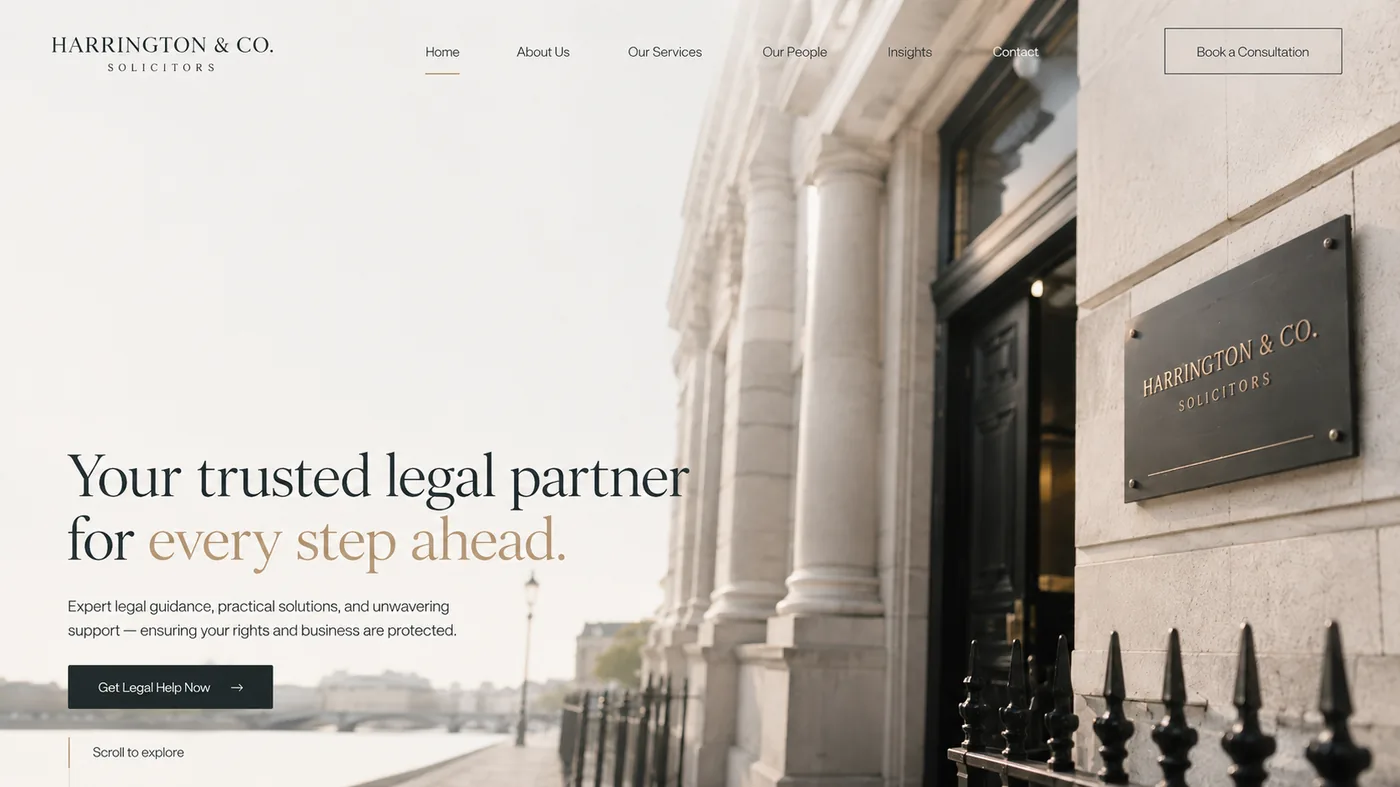
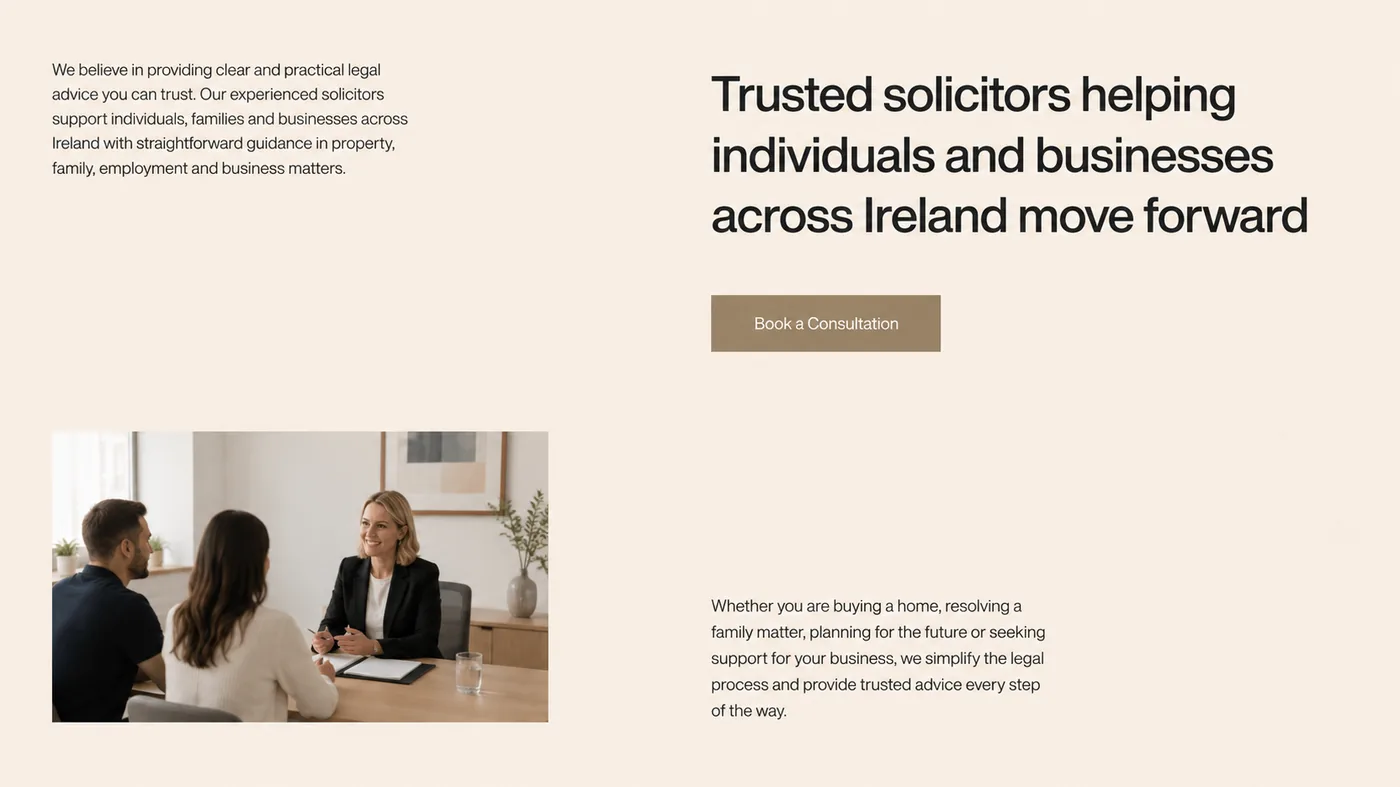
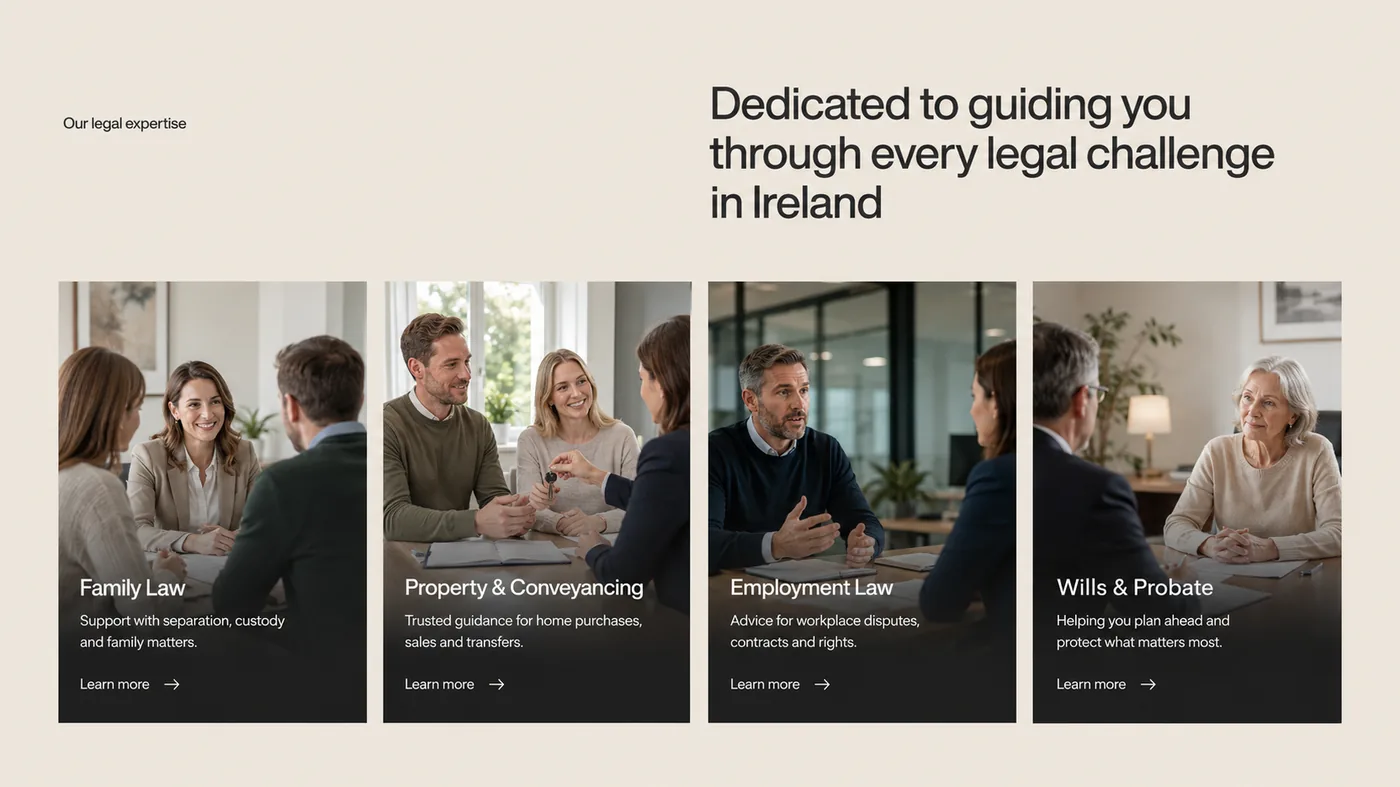
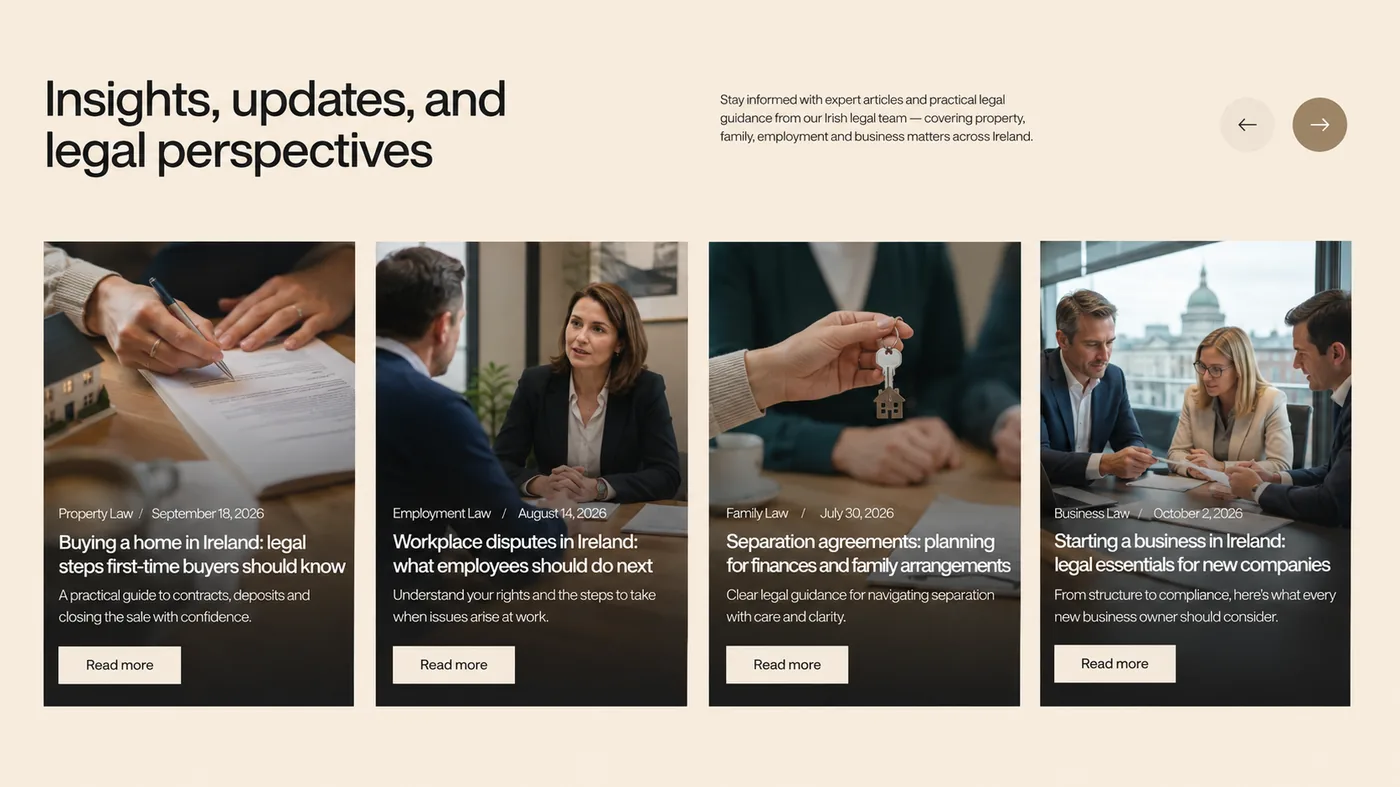
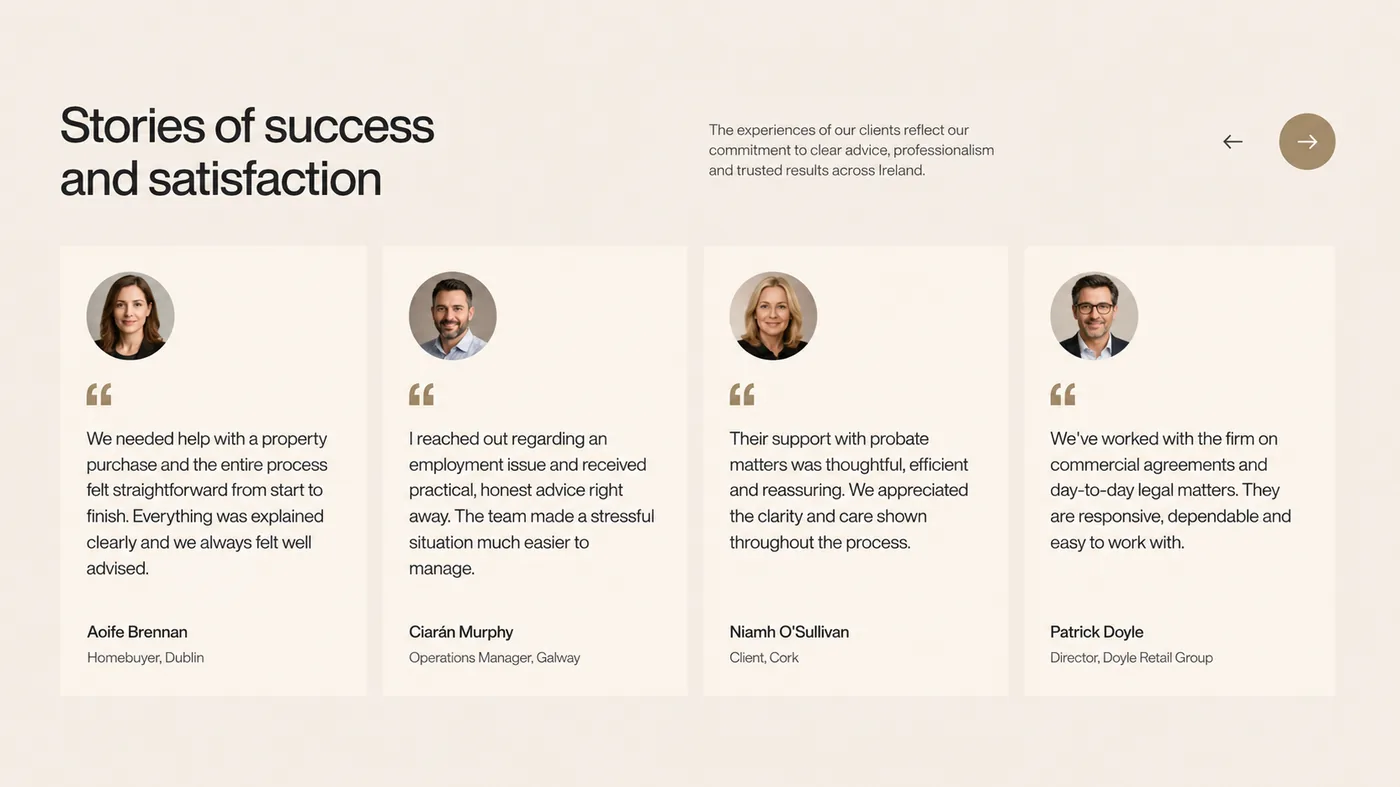
Previous example of work
How to Fix Each One
Heading structure
Every page should have exactly one H1, usually the page’s main title. Everything below it should step down logically, H2 for main sections, H3 for sub-points within them. On an older site, this is often a quick fix once someone knows what to look for in the page code.
SEO title
Write a unique, specific title for every page, combining the firm name, what the page covers, and the location, in that order or close to it. “Property Solicitors Kildare | Firm Name” beats a generic “Home”, or a title that’s identical across every page on the site.
Meta description
One or two sentences summarising what the page offers, written for a person rather than a search engine. Left blank, Google will pick a sentence from the page at random, usually a weaker first impression than anything the firm would have written.
NAP consistency
Pick one exact version of the firm’s name, address, and phone number, and use it identically everywhere it appears online. Small variations, a missing “Co.” before a county name, an old phone number left on one page, quietly damage local search rankings over time even though they look harmless.
The Cost of Getting This Wrong
None of this requires a total rebuild in most cases. But if a site has several of these issues stacked together, it compounds. Rankings drop, fewer people click through, and the ones who do click through are less convinced by what they see.
For a profession built entirely on trust and reputation, that’s an expensive gap to leave open.
Ready to Find Out Where Your Firm Stands?
If you’re a solicitor firm anywhere in Ireland and you’re not sure how your own website measures up on any of the four checks above, I’m happy to take a quick look and tell you straight. I build clean, modern, SEO-ready websites for solicitor firms, built on WordPress so they’re easy to manage day to day, with a year’s hosting and support included as standard. See how much a website costs in Ireland for a full pricing breakdown.
Want a real look at your firm’s website?
Take my free 2-minute SEO questionnaire and I’ll send you a personalised audit within 48 hours — real recommendations, no sales pitch.